In 1975 Porsche introduced the first Turbo. The engineers experienced this new engine and Chairman Ernst Fuhrman decided that they could use a turbo on a production car. The first prototype was displayed at several European shows in 1973. In 1974, 911 Turbo went on sale and at the time it had a 3.0 liter 260 bhp engine.
The new Porsche was full of luxury. The standard Turbo had air-conditioning, electric windows, tinted glass, headlamp washers, a leather interior and Bilstein shocks. Originally, it was supposed to be a limited edition, with only 500 models to be sold. However, the demand was so high that more than 1000 cars were sold. It was now clear that Turbo would have a secure future.
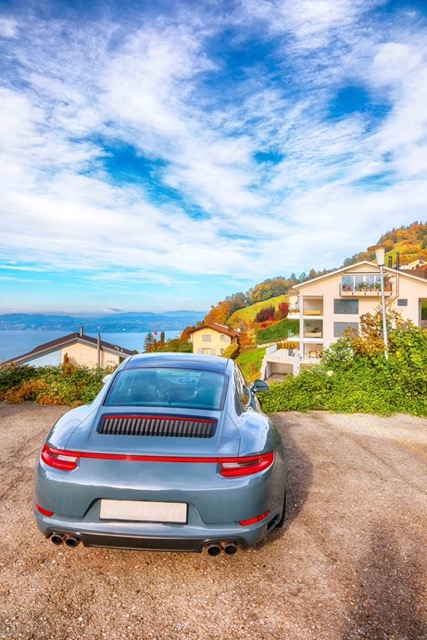
What attracted so many customers was its huge rear wing, widened wheel and big tires. This great look combined with the powerful engine made the Turbo look faster than any other 911.
In 1978, the model was improved by the increase of the engine capacity to 3.3 liter and some other modifications. Now the engine produced 40 bhp more. The rear wing was also revised: the two separate grilles were replaced by one larger smooth surface, placed a little higher in order to make room for an intercooler.
In 1979 though, the Turbo was withdrawn from US and Japan, as a response to the second energy crunch.
In 1986, Turbo became again available in the US. This was the first year Porsche used flares that were created in the stamping process of the fenders. In 1992 Porsche showed the Turbo S at Geneva’s Motorshow. Its engine delivered 381 bhp. The car weighted 120 kg less then the standard Turbo and this helped making Turbo S really fast. There were built only 80 Turbo S.
In 1993, the engine capacity was increased again, now reaching 3.6 liter. It was easily recognized by the Turbo 3.6 badge. Also, there was a 93 Turbo 3.6 based 911 Turbo S built.
In 1996 Porsche launched yet another Turbo, based on the 993 series. Its engine produced 408 bhp, featuring a six-speed gearbox and four-wheel drive. It looked more elegant thanks to the less evocative rear-wing. The wheels are 18 inch in diameter. It saves 20% of the weight because the five spokes are hollow. The front wing has air-ducts that lead extra cooling air to the brakes, making them more powerful than before. They can stop the Turbo from 100 hm/h in 2.6 seconds and from 200km/h in just 5 seconds, increasing cars safety.
Porsche has recently introduced the 996 Turbo. The styling is different from the previous Turbo models. Its aerodynamics are improved, making it much faster than the 993 Turbo. It gets to 100 km/h in only 4.2 seconds and has a top speed of 305 km/h. The new Turbo has a few details that make it easy to recognize: bi-xenon headlights, air intakes behind the doors and a movable rear-spoiler.
The Porsche Turbo has remained an icon of high-performance engineering since its debut in 1975. With each generation, Porsche refined the Turbo’s power, aerodynamics, and handling, creating one of the most sought-after sports cars in the world. From the aggressive stance of the early 3.0-liter models to the technological advancements of the modern 996 Turbo, Porsche’s ability to blend speed, luxury, and innovation has made the Turbo a benchmark in the automotive industry.
While the 911 Turbo represents Porsche’s relentless pursuit of turbocharged performance, the Porsche 928 took a different approach to speed and refinement. Designed as a luxurious grand tourer, the 928 emphasized high-speed stability, comfort, and a naturally aspirated V8 engine—a stark contrast to the rear-engine, turbocharged 911. Yet, both cars share Porsche’s engineering DNA, proving that performance can come in many forms. Whether it’s the raw power of a Turbo or the balanced precision of a 928, Porsche has always delivered driving experiences that stand the test of time.
Thank you for taking the time with me to learn more about what Mr. Done Right, the Porsche 928 whisperer, can do for you.
Sincerely,
Don Fenton
(AKA) Mr. Done Right
For more information on Porsche 928 maintenance, repair, or restoration in the greater Austin area (or beyond), please contact your premier 928 mechanic, Don Fenton, AKA Mr. Done Right – Porsche 928 repairs and restoration of Austin, because Don ensures any repairs get Done Right the first time!
📞 Call us now for a free estimate! (737) 900-8179
🌐 Visit us at www.928DoneRight.com
Recent Comments